Executive Engineering Analysis: Chinese Industrial Racking Manufacturing
A Comprehensive Technical Evaluation of Structural Steel Fabrication, Material Yield Strength, and Quality Assurance Protocols for Global Enterprise Logistics
Metallurgical Rigor & Yield Strength
Certified steel chemistry with yield strengths up to 355 MPa. Ultrasonic flaw detection eliminates internal structural inclusions prior to cold profiling.
Automated Robotic Welding
Dual-station ABB and Fanuc CO2 gas-shielded robotic welding arms ensure uniform weld penetration and zero thermal warping along beam connector hooks.
C1-C5 Surface Passivation
Pre-treatment including automatic phosphating and shot-blasting to SA2.5 standard, finished with AkzoNobel epoxy powder for 500+ hours salt-spray resistance.
Structural Engineering Benchmarks: RMI vs. FEM vs. EN Standards
- RMI (Rack Manufacturers Institute) / ANSI MH16.1: The prevailing standard across North America, focusing on perforations, beam-to-column connection stiffness, and sway buckling safety coefficients under combined dynamic forklift impact and live loads.
- FEM 10.2.02 / EN 15512: The European standard that dictates limit state design principles, requiring rigorous finite element analysis (FEA) to simulate secondary bending moments and global column frame stability.
- AS 4084-2012: The Australian standard governing steel storage racking, emphasizing stringent baseplate anchoring, floor slab shear transfer, and rack guard collision protection.
| Racking System Type | Typical Load Capacity | Cubic Space Utilization | Forklift Compatibility | Ideal Industry Application |
|---|---|---|---|---|
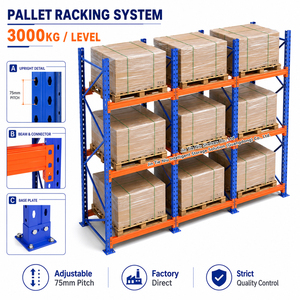
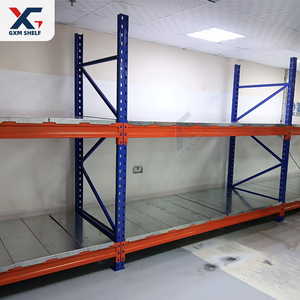
| Selective Pallet Racking | 1,000 kg – 4,000 kg / level | 40% – 50% Efficiency | Standard Counterbalance, Reach Truck | FMCG Distribution, General Warehousing |
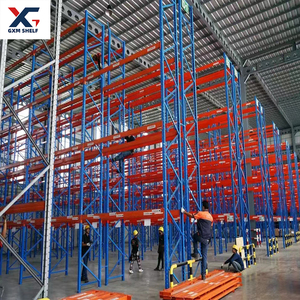
| Very Narrow Aisle (VNA) | 1,500 kg – 3,000 kg / level | 65% – 75% Efficiency | VNA Turret Truck, Wire-Guided AGV | High-Bay E-Commerce, Pharmaceuticals |
| Drive-In / Drive-Through | 1,000 kg – 2,000 kg / pallet | 70% – 85% Efficiency | Standard Reach Truck (Narrow Frame) | Cold Storage, Seasonal Bulk Items |
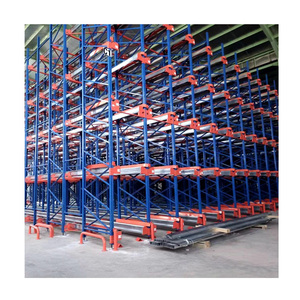
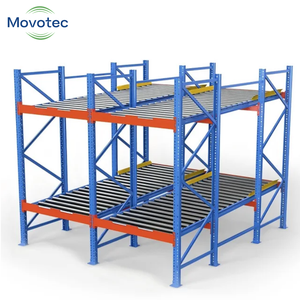
| Radio Shuttle Racking | 1,500 kg / pallet (Automated) | 80% – 90% Efficiency | Standard Forklift + Automated Shuttle | Food & Beverage, Deep-Freeze Facilities |
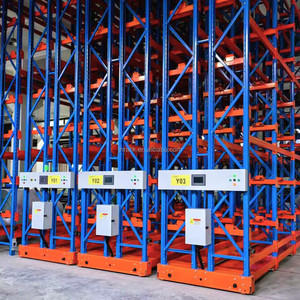
| Automated Mobile Racking | up to 24,000 kg / bay unit | 85% – 92% Efficiency | Conventional Counterbalance / Reach | High-Value Cold Chain, Archive Storage |
Future Procurement Trends in Industrial Storage (2025–2030)
How Automation, IoT Structural Monitoring, and Green Supply Chains are Redefining Heavy-Duty Racking Sourcing
1. Integration of Automated Radio Shuttle & AS/RS
Manual warehousing is rapidly transitioning to semi-automated and fully automated infrastructure. Procurement managers are increasingly requesting radio-shuttle ready rack channels fitted with precision optical sensor slots and low-friction galvanized guide rails to seamlessly accommodate pallet-carrying robots.
2. IoT Sensor Embedment & Strain Gauges
Next-generation racking installations incorporate structural micro-strain sensors and impact-detecting accelerometers directly into vertical column uprights. Real-time telemetry alerts operations leaders to minor fork-truck collisions or overload deflection before catastrophic structural failure occurs.
3. Decarbonization & Green Steel Sourcing
Global environmental mandates are driving B2B buyers to evaluate Scope 3 supply chain emissions. Leading Chinese manufacturers are adopting Electric Arc Furnace (EAF) steel making and solar-powered powder coating lines, providing verifiable carbon footprint documentation for international ESG compliance.
Factory Rigor: Original Manufacturer Strengths
Why global enterprise buyers partner directly with top-tier Chinese manufacturing facilities:
16-24 Pass Continuous Roll Forming Lines
Unlike smaller workshops that use simple press brakes, tier-one factories employ continuous multi-pass roll forming mills. This ensures uniform material thickness across complex upright profile geometries (e.g., 85mm to 120mm face profiles) with structural dimensional tolerances under 0.05mm.
In-House Load Testing Rig & Destructive Analysis
Every custom beam profile and connector hook configuration undergoes full-scale destructive load testing. Vertical hydraulic rams simulate asymmetrical floor load distribution, verifying safety lock pin shear resistance and ultimate failure limits well beyond nominal design capacities.
Container Loading Optimization & Export Packing
Exporting heavy cold-formed steel profiles requires meticulous bundle packaging. Frame uprights and beam bundles are banded with steel strapping, protected by plastic film wraps, and mounted on wood-skid cradles to prevent ocean transit damage and maximize 40ft HQ container CBM efficiency.
Custom OEM/ODM Engineering Support
Experienced factory engineering teams utilize AutoCAD and Tekla Structures to generate 3D spatial models and structural calculation reports tailored specifically to local building codes, soil bearing conditions, and seismic zone accelerations.
Procurement FAQ: Sourcing Chinese Pallet Racking
Technical and logistical guidance for procurement directors, logistics engineers, and warehouse managers
Optimize Your Warehouse Cubic Capacity Today
Consult with our senior structural engineers to receive a customized 3D layout design, finite element load analysis, and direct factory price quote.
Get a Quote