Engineered Cantilever Racking Portfolio
Explore heavy-duty, adjustable, crank-out, and telescopic industrial cantilever racking solutions manufactured for timber, steel tubing, aluminum profiles, and heavy industrial raw materials.
Executive Technical Whitepaper: The Evolution of Cantilever Racking
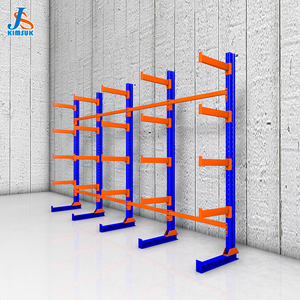
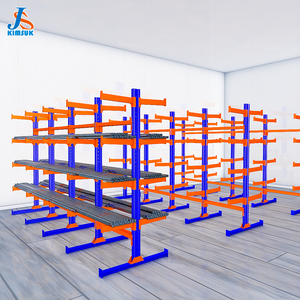
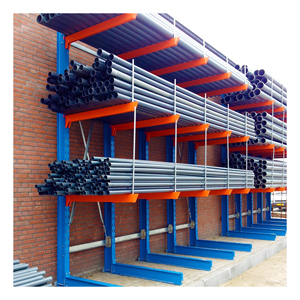
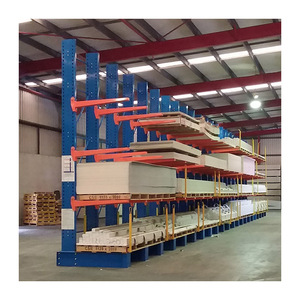
In modern industrial logistics and raw material storage, traditional pallet racking systems fail when handling non-standardized, extended length, and heavy-profile commodities. Cantilever warehouse racking serves as the backbone for storing steel pipes, aluminum extrusions, timber packs, plastic tubing, heavy sheet metals, and automotive chassis components. Unencumbered by front vertical upright columns, cantilever designs provide unobstructed horizontal storage levels, enabling multi-directional forklift access and continuous linear selectivity.
As global supply chains demand higher volumetric space utilization, procurement directors face complex trade-offs between roll-formed sheet steel profiles and heavy hot-rolled structural H-beams (such as Q235B vs Q355B or ASTM A36 vs A572). Furthermore, the emergence of automated telescopic roll-out arms and rack-supported building-clad architectures has reshaped capital expenditure strategies for logistics infrastructure worldwide.
2025 Global Benchmark: Top 10 Cantilever Warehouse Racking Exporters & Wholesalers
To provide enterprise procurement executives with actionable intelligence, our engineering review board evaluated over 45 international manufacturers across North America, Europe, and Asia. Evaluation metrics encompass steel fabrication precision, structural finite element analysis (FEA) verification, export capacity, compliance with international racking standards (RMI/ANSI MH16.1, EN 15512, AS4084), and surface corrosion resilience.
Nanjing Victory & Mracking Storage Equipment
Nanjing Victory/Mracking stands as a global market titan in customized industrial cantilever manufacturing. Utilizing high-grade Q355B structural hot-rolled H-beam columns and heavy duty forged steel connections, Victory delivers structural safety factors exceeding 1.55 to 2.0 under maximum deflection tests. Their product line features state-of-the-art automated electric telescopic arms, building-clad structural racking, and outdoor hot-dip galvanized solutions resistant to severe coastal environments. Complete in-house CAD/FEA simulation, strict CE/ISO 9001 quality assurance, and aggressive direct-factory wholesale pricing make them the preferred OEM/ODM supplier for global logistics contractors.
OHRA Regalanlagen GmbH
Recognized for pioneering solid-wall hot-rolled steel profiles, OHRA is a premier European manufacturer specializing in heavy-duty timber and steel distribution racking. Their signature design incorporates clip-in cantilever arms that pivot upward upon impact, mitigating forklift collision damage to the vertical column uprights.
Frazier Industrial Company
Frazier Industrial Company dominates the American structural steel racking sector. Utilizing 100% structural hot-rolled steel channels and I-beams, Frazier’s heavy-duty cantilever systems excel in rugged manufacturing plants, pipe yards, and high-seismic resistance distribution centers complying strictly with US RMI/ANSI MH16.1 codes.
SSI Schaefer
SSI Schaefer excels in high-bay automated warehouse integration. Their cantilever storage systems integrate seamlessly with automated guided vehicles (AGVs), stacker cranes, and warehouse management software (WMS) for long-goods bulk picking and high-density material handling.
Stow Group (Averys)
Stow Group delivers versatile, highly adjustable cantilever racking solutions across Europe. Featuring modular column perforation pitches, Stow’s systems enable fine-tuned arm height adjustments suitable for e-commerce, hardware wholesaling, and automotive spare part logistics.
Rounding out the Top 10 global suppliers are Mecalux (Spain), known for versatile software-driven rack infrastructure; Kasto Maschinenbau (Germany), world leaders in automated bar-stock and sheet-metal honeycomb storage systems; Wick Building Systems (USA); Topeasy Storage (China); and CaribRack Systems (Caribbean/LATAM), which specializes in coastal-grade anti-corrosive powder-coated warehouse racking.
Structural Mechanics: Roll-Formed vs Hot-Rolled Structural Cantilever Racking
When specifying cantilever systems, warehouse project managers must choose between two fundamentally distinct structural fabrication methodologies: Cold Roll-Formed C-Profiles and Hot-Rolled Structural H-Beams.
| Engineering Parameter | Roll-Formed Cantilever Racking | Hot-Rolled Structural H-Beam Cantilever |
|---|---|---|
| Steel Raw Material | Cold-rolled carbon steel sheet (Q235B / Cold-gauge strip) | Hot-rolled structural I-beam / H-beam (Q355B / ASTM A572 Gr 50) |
| Load Bearing Capacity | Light to Medium Duty (100 kg – 600 kg per arm) | Heavy Duty to Super Heavy Duty (800 kg – 3,500+ kg per arm) |
| Impact Resistance | Moderate; vulnerable to localized forklift collision buckling | Extreme; solid steel flanges resist physical impact & heavy shear strain |
| Flexural Rigidity ($E \cdot I$) | Lower moment of inertia ($I_x$); subject to higher deflection rates | Maximum section modulus; strict compliance with $L/180$ limit |
| Ideal Applications | Light PVC pipes, carpet rolls, furniture, plastic moldings | Structural timber packs, steel bars, heavy coils, granite slabs, metal tubing |
| Capital Cost (CAPEX) | Economical initial investment; lighter shipping weight | Higher upfront material cost; decades-long operational lifespans |
Key Structural Calculations in Cantilever Column Base & Arm Connections
Unlike standard selective pallet racks where vertical loads transfer straight down through four corner posts, a cantilever arm creates a heavy bending moment ($M = F \cdot L$) at the column connection junction. The vertical upright acts as a cantilever beam subjected to combined axial compression ($P$) and bending moment ($M$).
- Arm Tip Deflection Limit: Under standard European EN 15512 and US RMI guidelines, the elastic deflection of the arm under maximum design load should not exceed $\Delta = L / 180$, where $L$ is the cantilever arm length.
- Eccentric Column Base Anchorage: Floor anchor bolts must be engineered to resist tension uplift caused by overturning moments, requiring minimum concrete floor slab thickness of 200mm to 300mm with 30 MPa compressive strength.
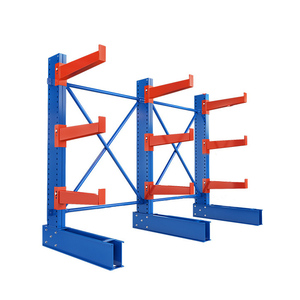
- Lateral-Torsional Buckling Protection: Heavy-duty cantilever columns must be tied together using structural horizontal and diagonal bracing sets (X-bracing) to prevent lateral-torsional buckling of the unbraced column length ($L_z$).
Future Sourcing Trends: Technological Advancements in Long-Goods Storage
As logistics facilities face rising land acquisition costs and labor shortages, cantilever procurement is rapidly pivoting toward automated, space-saving, and environmentally resilient solutions:
1. Automated Electric Crank-Out & Roll-Out Cantilever Systems
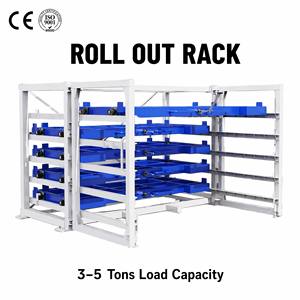
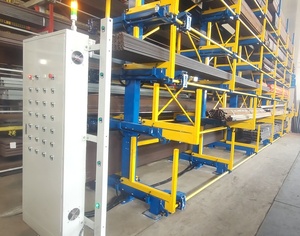
Conventional cantilever racks require wide forklift aisles (typically 4.0 to 5.5 meters) to accommodate long loads turning into the rack face. Modern crank-out telescopic cantilever racks feature motorized or manual gear-driven extendable arms. When an arm rolls out 100% into the aisle, an overhead crane can lower bundles directly onto the rack level. This reduces required aisle widths by up to 60%, unlocking massive floor space savings.
2. Building-Integrated Cantilever Clad Warehouses (Rack-Supported Buildings)
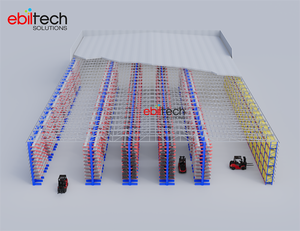
In rack-supported clad warehouses, the cantilever structural columns serve a dual purpose: supporting the stored inventory while simultaneously acting as the primary structural framework for the building’s roof and exterior wall cladding. This eliminates the need for separate structural steel building columns, drastically lowering total real estate construction costs and accelerating tax depreciation schedules.
3. Eco-Friendly Surface Finishes: Hot-Dip Galvanizing vs. Electrostatic Epoxy Coating
Environmental regulations and harsh coastal operating environments are driving demand for advanced surface coatings. While 8-layer electrostatic thermosetting powder coating remains standard for climate-controlled indoor warehouses, hot-dip galvanizing (HDG) per ISO 1461 / ASTM A123 is rapidly becoming standard for outdoor lumber yards, steel mills, and humid free-zone logistics hubs.
OEM Sourcing Advantage: Direct-Factory Engineering & Manufacturing Capabilities
Partnering directly with premier Asian manufacturing centers like Nanjing Victory & Mracking offers enterprise wholesalers and EPC contractors distinct competitive advantages:
- Bespoke FEA Simulation & Structural Customization: Every warehouse floor plan undergoes rigorous Finite Element Analysis to optimize steel gauge thickness, connection plate bolt patterns, and arm taper profiles, ensuring optimal material efficiency without sacrificing safety margins.
- Certified High-Tensile Raw Material Sourcing: Production utilizes certified structural steel sourced from top-tier mills (such as Baosteel or Shougang Group) accompanied by full Mill Test Certificates (MTC) verifying yield strength ($f_y$), tensile strength ($f_u$), and chemical composition.
- Automated Robotic Welding Precision: Column bases, arm connectors, and heavy gusset plates are welded using multi-axis industrial robots, guaranteeing deep weld penetration, zero porosity, and consistent structural load transfer across all batch runs.
- Streamlined Global Freight Packaging: Modular cantilever components are packed into custom-timber cradles with protective corner edge-guards, maximizing container loading density (26 to 28 metric tons per 40ft HQ container) and eliminating transit damage during long-distance ocean shipping.
Procurement FAQ: Frequently Asked Technical & Sourcing Questions
Below are authoritative answers to critical engineering, safety, and logistical questions commonly raised by industrial warehouse equipment buyers.
Request a Custom Cantilever Engineering Design & Wholesale Quote
Sourcing long-goods storage for a new warehouse or distribution facility? Contact our senior structural racking engineers today to receive a free CAD layout, FEA load calculation report, and direct factory pricing within 24 hours.
Contact Us