Engineered Warehouse Racking Solutions
Explore our heavy-duty steel selective, push-back, and customized industrial pallet racks crafted for maximum volumetric efficiency and structural integrity.
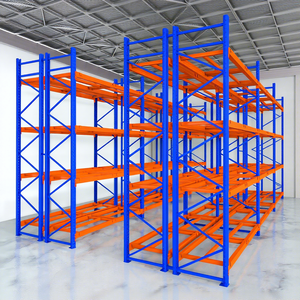
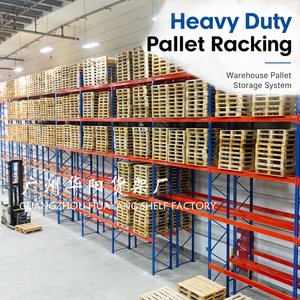
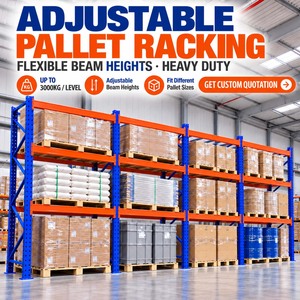
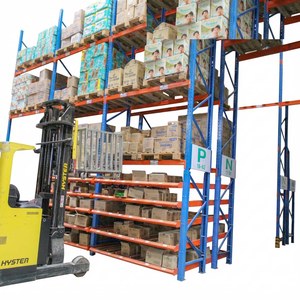
Technical Whitepaper: Push Back Pallet Racking Engineering & Manufacturing Leadership
As modern distribution centers face escalating real estate acquisition costs and demand for higher volumetric density, selecting the correct structural storage architecture becomes a critical capital expenditure decision. Among high-density pallet storage configurations, Push Back Pallet Racking Systems stand out as the optimum engineering solution that balances high floor space utilization with superior SKU selectivity compared to traditional Drive-In or Deep Lane storage systems.
Core Engineering Principle: Push Back racking utilizes dynamic nested carts riding on inclined structural steel rails (typically angled between 1.5° and 3.0°). Operating on a Last-In, First-Out (LIFO) inventory management framework, the system allows forklifts to deposit up to 6 pallets deep per lane without entering the physical rack structure—significantly mitigating structural impact risk and reducing cycle loading times by up to 40%.
1. Kinematic Mechanics & Dynamic Cart Design
The operational excellence of China’s leading Push Back racking manufacturing hinges on structural tolerances, rolling resistance friction coefficients, and safety deceleration mechanisms. Unlike standard selective racking where loads sit stationary on horizontal beams, a push-back system relies on kinetic gravity principles.
When a forklift places the first pallet on the topmost (front) nested cart, it occupies Position 1. To store a second pallet, the forklift operator aligns the second unit load against the first pallet, pushing it backwards into the lane. This action retracts the top cart, revealing the underlying cart for Position 2. For 3-deep, 4-deep, 5-deep, or 6-deep configurations, sequential nested steel carts stack telescopically underneath each other. Upon retrieval, gravity gently flows the trailing pallets forward to the pick face, controlled by precision-engineered inclination profiles and heavy-duty steel wheels equipped with sealed, maintenance-free ball bearings.
Telescopic Nesting Carts
Low-profile, heavy-gauge cold-rolled steel carts designed with minimal height loss to optimize total available vertical bay clearance.
Flow Deceleration Bumpers
Integrated mechanical safety stops and specialized rubber impact dampers prevent kinetic overrun during rapid forward pallet descent.
High-Tensile Steel Profiles
Formed from premium Q235B and high-yield Q355B micro-alloyed steel, conforming strictly to EN 10025-2 and ASTM standards.
2. Structural Engineering & Steel Material Metallurgy
As an authoritative OEM/ODM factory in China, structural design integrity remains paramount. Push-back racking systems must withstand significant dynamic thrust forces imparted during the push-back phase, as well as high static vertical load forces when fully loaded. We utilize advanced Finite Element Analysis (FEA) software to model stress distribution across upright frames, load beams, cross-ties, and incline rail anchors.
Upright columns are cold-roll-formed into complex multi-flanged profile geometries (such as 80mm to 120mm profiles with 13-15 distinct bending points). This profile engineering drastically improves resistance against torsional buckling and flexural deformation under heavy asymmetric loading. Beam-to-frame connections feature 4-hook or 5-hook heavy-duty drop-forged connectors equipped with automatic safety locks to prevent accidental dislodgement during forklift maneuvering.
3. Comparative System Performance Matrix
To evaluate whether Push Back Pallet Racking is the optimal engineering choice for your facility, compare its operational parameters against conventional high-density warehouse systems:
| Racking Storage Type | Floor Space Efficiency | SKU Selectivity | Handling Speed / Cycle Time | Forklift Damage Risk | Management Model |
|---|---|---|---|---|---|
| Push Back Racking | High (Up to 75%) | Good (Per lane access) | Fast (No rack entry) | Very Low | LIFO |
| Selective Pallet Rack | Baseline (35% - 40%) | 100% Immediate | Moderate | Moderate | FIFO / LIFO |
| Drive-In Racking | Very High (Up to 85%) | Poor (Per block access) | Slow (Requires entering rack) | High | LIFO |
| Radio Shuttle Racking | Maximum (Up to 88%) | Moderate-High | Very Fast (Automated) | Very Low | FIFO / LIFO |
| Double Deep Racking | Medium (Up to 55%) | 50% Immediate | Moderate (Deep reach needed) | Low-Moderate | LIFO |
4. Future Global Procurement Trends in Industrial Storage (2025–2030)
The global warehousing and logistics industry is undergoing a seismic shift toward automation integration, environmental sustainability, and regional supply chain resilience. Procurement managers sourcing racking equipment from leading Chinese manufacturers must consider four transformative trends:
- Hybrid Automation Integration: Modern push-back systems are increasingly engineered to work alongside Automated Guided Vehicles (AGVs) and Autonomous Mobile Robots (AMRs). Precision cart alignment tolerances (within ±1.5mm) ensure robotic forks can load and retrieve push-back lanes reliably.
- Cold Chain Specialization & Anti-Corrosion Finishes: With global demand for refrigerated food logistics surging, push-back racking systems installed in cold rooms (-30°C) require specialized epoxy powder coatings or hot-dip galvanizing (HDG) per ISO 1461 to prevent steel embrittlement and surface oxidation caused by continuous condensation cycles.
- Seismic Resilience & Global Building Codes: International procurement specifications now demand compliance with rigorous seismic design criteria, such as US RMI/ANSI MH16.1, European EN 15512, and local seismic acceleration coefficients (e.g., Dominican Republic R-001 or Chilean NCh2369 standards). Specialized heavy baseplates and anchor bolt embedded depths are custom-calculated for active fault zones.
- Steel Traceability & Green Manufacturing: Tier-1 Chinese racking factories now provide total steel batch mill certificates (EN 10204 3.1) and implement low-carbon electrostatic powder coating lines with closed-loop wastewater recovery systems, helping international buyers meet ESG compliance benchmarks.
Why Partner With Our Factory: Advanced Manufacturing Advantage
As a premiere Chinese manufacturing facility specializing in structural industrial storage systems, we offer global partners an uncompromised blend of engineering precision, cost competitiveness, and end-to-end quality assurance.
Automated CNC Production Lines
Our facility houses 18 continuous cold-roll forming lines, high-precision laser cutting cells, and robotic welding stations that guarantee consistent weld penetration and dimensional uniformity.
Strict ISO & CE Certification
Every manufacturing step follows ISO 9001 quality management procedures. Products undergo rigorous destructive load testing, beam deflection testing (L/200 standard), and salt spray corrosion testing.
Turnkey OEM/ODM Global Delivery
We provide structural CAD layout drawings, 3D BIM modeling, export-grade bay packaging with component labeling, custom ocean freight container stuffing, and remote installation guidance.
Frequently Asked Questions: Global Procurement & Engineering Insights
Clear, authoritative technical answers to common queries raised by warehouse managers, structural consultants, and procurement directors when sourcing push-back and heavy-duty storage racking systems from China.
The primary difference lies in the number of nested carts, rail elevation height, and required forklift pushing power. A 2-deep system requires only 1 nested cart per lane (the second pallet sits directly on the incline rail). A 4-deep system uses 3 nested carts riding telescopically on multi-tier tracks, while a 6-deep system requires 5 nested carts. As depth increases, the top cart’s starting height increases slightly, which must be factored into vertical beam spacing and clear height calculations. Additionally, deeper lanes require forklifts with sufficient engine power and traction to overcome cumulative push resistance across multiple weighted carts.
Yes. Custom engineering of the nested cart frame is standard practice in our manufacturing facility. Because pallets rest on structural steel cart cross-members rather than narrow incline rails directly, push-back systems are much more forgiving of bottom-board orientation and minor pallet damage than drive-in or gravity flow racks. We routinely design carts with full perimeter support grids to accommodate standard 48" x 40" GMA pallets, 1200 x 800mm Euro pallets, 1200 x 1000mm industrial pallets, or plastic/wire pallets seamlessly within the same system.
Our engineering team performs project-specific structural design checks in accordance with international standards, such as RMI/ANSI MH16.1 (USA), EN 15512 (Europe), and AS 4084 (Australia). We calculate dynamic seismic response spectra based on your facility's soil classification and peak ground acceleration (PGA). Structural adjustments include enlarging heavy-duty baseplates, increasing column section profiles, using high-tensile anchor bolts (such as Hilti chemical anchors), and adding heavy x-bracing towers behind the push-back blocks.
For standard dry ambient warehouses, our architectural-grade electrostatic epoxy powder coating (60-80 microns thickness) provides superior impact and scratch resistance. For cold storage facilities (-30°C) or coastal locations subject to salt spray air, we recommend either hot-dip galvanizing (HDG) per ASTM A123 / ISO 1461 (yielding a zinc coating of 65-85 microns) or a dual-layer zinc-rich epoxy primer topped with thermosetting powder coat. This prevents rust formation, flake peeling, and localized structural corrosion.
Export packaging is engineered with equal care as structural manufacturing. Upright frames are bundled with protective corner guards and heavy poly-strapping. Beams and inclined rails are steel-banded on custom timber skids with wooden dunnage separators to prevent steel-on-steel friction during sea transport. Nested carts and wheel assemblies are packed in reinforced ISPM-15 compliant wooden crates with moisture-absorbent desiccant packs to avoid surface condensation tarnishing during long transit times.
Ready to Optimize Your Warehouse Capacity?
Connect directly with our senior racking design engineers. Submit your warehouse floor plan, floor load specs, and pallet dimensions for a customized 3D layout drawing and competitive factory-direct quote.
Send an Inquiry